
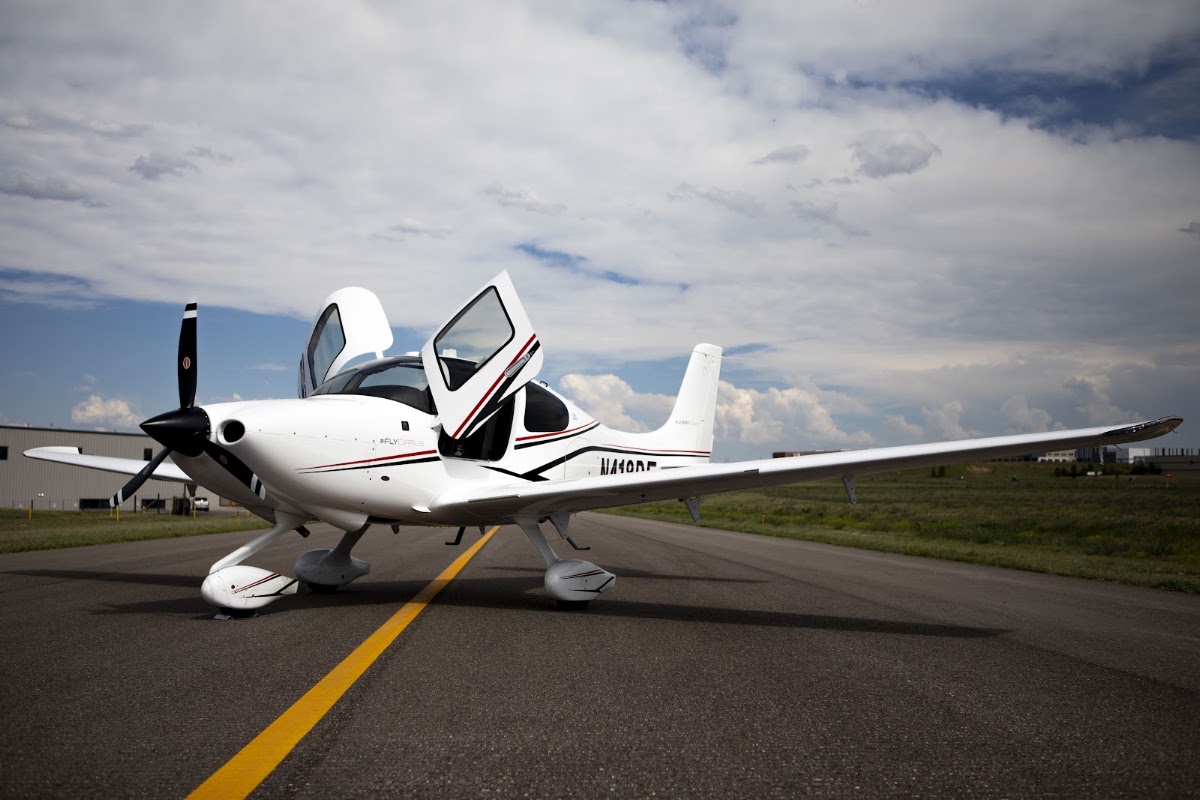
Independence Aviation made a decision in 2007 that most flight schools never make: pick one airframe and build the entire operation around it. Nearly twenty years later the school flies Cirrus SR20s and SR22Ts out of Box J-15 on Control Tower Road, holds Platinum Partner status with Cirrus Aircraft, and has been named Cirrus Training Center of the Year for North America — the first school ever to receive that award, and again in more recent years.
That focus is the whole story. Understand what it buys and what it costs and you will know within a paragraph whether this is your school.
Training in a Cirrus Is Not Training in a Cessna
The SR-series airplane is fast, slick, and side-stick controlled, with a full glass panel and a whole-airframe parachute. None of that makes it hard to fly. What it does is move where the difficulty lives.
A student in a 172 spends most of their effort on stick and rudder and comparatively little on systems and automation. A student in an SR22T inverts that. The airplane will hold an altitude and track a course better than you will; the skill actually being trained is knowing what the automation is doing, when to switch it off, and how to manage energy in an airframe that does not want to slow down. Descent planning is a genuine discipline in a Cirrus in a way it simply is not in a trainer that decelerates the moment you pull the power back.
Then there is CAPS. The parachute is not a gimmick and it is not a substitute for airmanship, but the decision to pull it is a trained response with its own altitude gates and its own scenario set, and it gets drilled here. That training is a large part of why Cirrus accident outcomes changed so sharply over the last fifteen years, and it is the single thing an owner most needs from a training provider.
What They Teach
The course list is short and deliberately so. Every item on it exists because a Cirrus owner or a future one needs it.
| Program | Built for | Where you start |
|---|---|---|
| Private pilot | New pilots who intend to fly a Cirrus, not just any airplane | Zero hours |
| Cirrus Instrument Rating Program | Owners who want to fly real trips in real weather | Private certificate |
| Commercial pilot | Pilots continuing toward professional work | Instrument rating |
| Cirrus transition training | Pilots moving into the airframe from something else | Certificate plus whatever dual your insurer demands |
| Mountain flying | Anyone flying west of the Front Range | Private certificate |
| IA-P proficiency and mentoring | Owners staying sharp year-round | Any certificate level |
There is also a Private Pilot Kickstart package for new students, bundling several things that would otherwise be billed separately:
- 20 hours of aircraft rental
- 7 hours of simulator time
- 30 hours of instructor time
- 90 days of membership included
Ask for current terms before you build a budget around it. Packages like this get restructured.
The Instructor Roster
Worth stating plainly: this school has produced unusually decorated instructors. The FAA National Flight Instructor of the Year for 2017 has been on the roster, along with regional Flight Instructor of the Year nominees in other years, and the school has taken an EAA Flight Training Excellence Award.
Awards do not fly the airplane. But in a field where instructor turnover is the industry norm, where most CFIs are hour-building and gone inside eighteen months, a school that keeps career instructors long enough for them to earn national recognition is telling you something real about how it is run. If continuity matters to you, ask how long the specific CFI you are assigned has been there.
Mountain Flying and the Colorado Factor
Centennial sits at 5,885 feet with a Class D tower and three runways, and summer afternoons routinely push density altitude past 9,000 feet. That is the baseline before you go anywhere. Twenty minutes west, the terrain climbs to fourteen thousand.
Mountain training is not an optional flourish in this part of the country. It is the difference between an airplane that can take you somewhere interesting and one that will only ever fly the Front Range. Independence teaches it as a distinct course covering the aerodynamics of thin air, terrain and wind interaction, canyon and valley procedures, weather that builds fast in the afternoon, and the go/no-go discipline that keeps pilots out of the accident reports. A turbocharged SR22T is a genuinely capable mountain airplane in trained hands, and a fast way into trouble without that training.
If you are buying a Cirrus, book the transition training before the airplane arrives, not after. Insurers typically require a set number of dual hours in type before they will write solo coverage, and a school with current-generation aircraft on the ramp can log those hours while your airplane is still in pre-buy or paint. Ask your underwriter for the specific hour requirement first — it varies by policy and by your total time.
Fleet and the Second Location
SR20s and SR22Ts, weighted toward the newer G6 and G7 generations. The school also operates from Rocky Mountain Metropolitan Airport in Broomfield, which is useful if you live north of Denver; the same programs run at both fields, so a move or a job change does not mean starting over.
Independence also handles aircraft management and charter, which means the operation touches ownership from several directions at once. It can train you, manage the airplane, and help offset the cost of holding it. Whether you want all three from one vendor is a fair question to think through, but the option is there and it is uncommon.
Who It Fits
Owners and prospective owners of Cirrus aircraft, first and above everything else. If you have bought or are buying an SR20 or SR22, this is the obvious choice at Centennial and one of the strongest options anywhere in the country.
Ab initio students should think harder about it. Learning to fly in an SR20 is entirely legal, well supported here, and produces a competent pilot — but it costs meaningfully more per hour than a 172, and the certificate you earn at the end is the same certificate. If the goal is an airline seat, that money buys more hours in a cheaper airframe somewhere else on this field. If the goal is to own a Cirrus and fly your family over the Rockies for the next twenty years, learning in the airplane you will actually fly is the better argument, and this is the school built to make it.
What Visitors Say
Pulled from Google reviews, unedited. We do not moderate or curate these — they are what the public left.
★★★★★ 3 weeks agoI don't often leave reviews, but IA has been so great to me that I felt like I just had to share my experience so far. From day one, the entire experience has been outstanding. I started with a discovery flight and knew within a few days that I wanted to begin working toward my Private Pilot License with them. The aircraft are always spotless and well-maintained, the staff is friendly and welcoming, and everyone g...
Nikolas Diamantopoulos
★★★★★ 4 months agoMy son recently earned his Private Pilot Certificate after training with Independence Aviation, and we couldn’t be happier with our experience. From day one, the team stood out for their professionalism, flexibility, and genuine commitment to student success. Choosing them over other options at KBJC was absolutely the right decision and we’re confident he’s starting his aviation journey on a much stronger foundati...
Brian Hartman
★★★★★ 6 months agoI’ve been curious about flying for years and the discovery flight was such a great introduction. Sydney was a fantastic instructor/pilot and really made sure I was completely comfortable with what we were doing. It was such a comprehensive/immersive experience. Just being in the front seat for the first time took some getting used to, but Sydney made it feel so routine! I could not have had a better introduction a...
Ian Gordon