

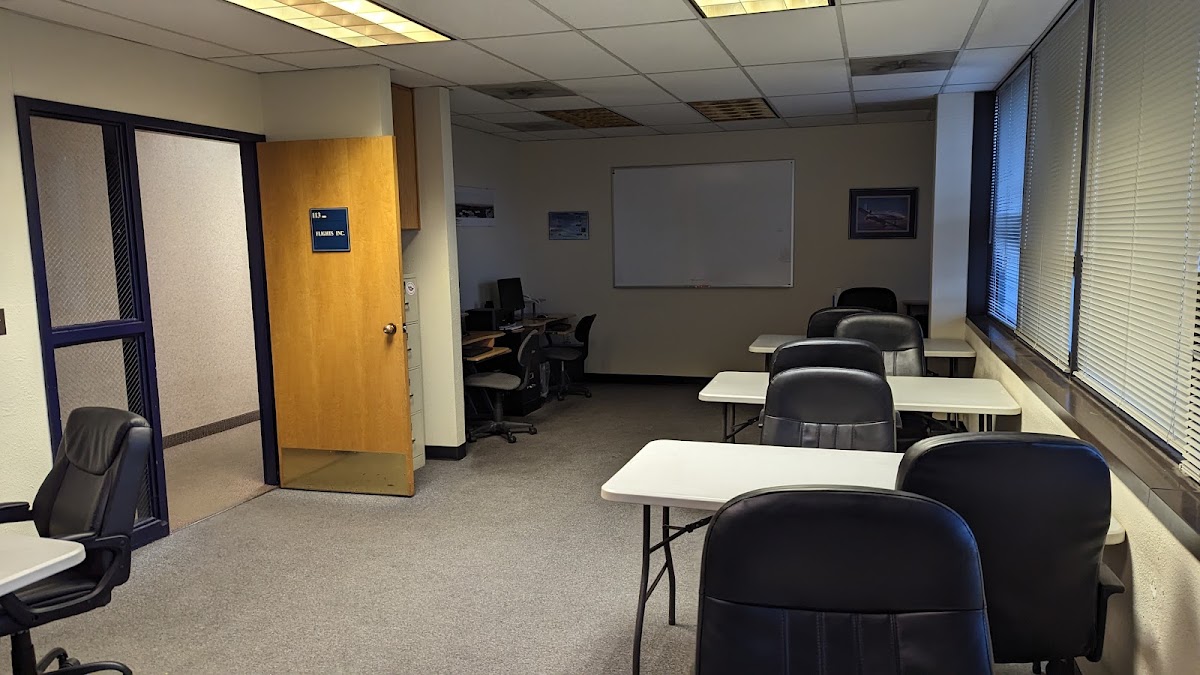
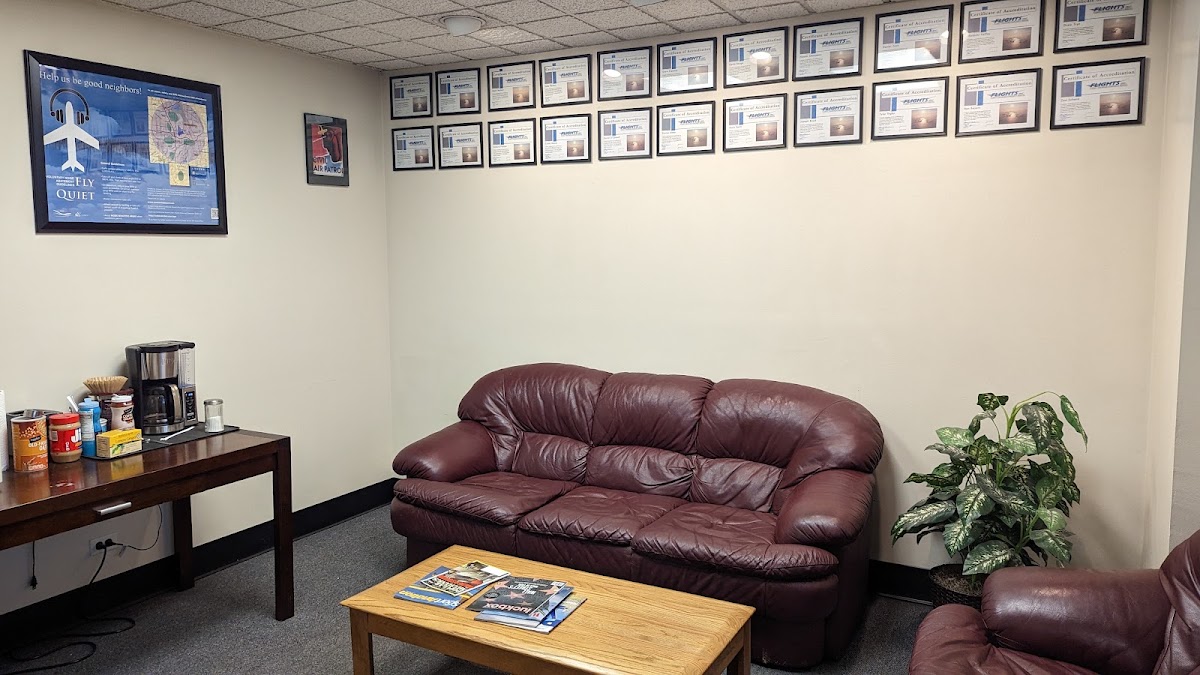
Flights Inc operates out of Hangar 10 on South Peoria Street, near the 17L run-up area. It is family owned, it does its own maintenance, and it has been renting and instructing at Centennial long enough that local pilots offer the name without being asked. Roughly twenty-two airplanes, one shop, one set of standards.
The Fleet, and Why It Is Built This Way
Most rental fleets accumulate rather than get designed. Somebody buys a 172 with a King stack, a Cherokee turns up on leaseback, a 182 with a Garmin panel gets added, and the school ends up with a dozen airplanes that have nothing in common but a tiedown. Flights Inc went the other direction and standardized around the Cessna family.
| Type | Count | Panel | Published rate |
|---|---|---|---|
| Cessna 172 | 7 | King avionics, L3 Lynx GPS | $170 / hour |
| Cessna 172 G1000 | 10 | Garmin G1000, some with GFC 700 autopilot | $180 / hour |
| Cessna 182 | 3 | Mix of King and G1000, 230 hp | $200–$210 / hour |
| Piper Seminole | 2 | Garmin G500 / GTN 650, 180 hp per side | $314 / hour |
Rates as published by the school; confirm before you schedule. The single-engine Cessnas carry 53 gallons, the 182s hold 88, and the Seminoles hold 108 — worth committing to memory if you plan to do your own cross-country fuel planning here rather than trusting whatever the previous renter left in the tanks.
What that fleet supports, in practice:
- Primary training and solo work in the King-panel 172s, the cheapest line on the card
- Instrument training in either panel, with G1000 and GFC 700 autopilot available when you want them
- Higher-performance time in the 230 hp, constant-speed 182s
- Multi-engine training and time building in the Seminoles
- Cross-country rental for certificated pilots, with 88 gallons in the 182s for the longer legs
Ten of the seventeen 172s carry G1000 panels, several with GFC 700 autopilot. That distribution matters most to instrument students. A pilot who earns the rating on a G1000 with a coupled autopilot and then rents a King-panel 172 has to rebuild the scan from scratch; going the other direction is usually easier. Having both panels under one roof means you can train across them deliberately instead of becoming a specialist in one by accident.
In-House Maintenance
This is the thing that separates Flights Inc from most of its competition, and it deserves its own section.
When a rental fleet is maintained by an outside shop, a squawk becomes a scheduling problem. The airplane goes down, it waits for a slot, and the school has no say in how long that takes. When maintenance lives in the same building as dispatch, the loop closes faster. Grounded airplanes come back sooner, small squawks get fixed before they turn into large ones, and the people signing off the work are the same people who see the airplane every day. For students, the practical result is fewer canceled lessons. For renters, it is a fleet where the discrepancy list stays short.
It also means you can walk over and ask a mechanic a question. That sounds trivial until you are a student pilot trying to understand what a cylinder compression number actually implies about the engine you are about to fly behind.
Training Structure
Flights Inc runs a written syllabus with stage checks administered by the chief pilot. That is a Part 141 habit applied inside a flexible school, and for most students it is the best of both.
The failure mode of unstructured training is not that students learn the wrong things. It is that nobody outside the instructor-student pair ever audits progress. Weak spots get carried forward, habits calcify, and the first honest measurement happens on the checkride. A stage check flown with someone who has never flown with you before is a real audit, and it catches drift early enough to fix cheaply. When you interview the school, ask where the stage checks fall in the syllabus and who conducts them.
Discovery flights run in the 172s and are the normal way in. If you have never flown a small airplane, do one before you spend money on anything else — headset, ground school, medical. An hour in the left seat settles questions that no amount of reading will.
Flying Out of Hangar 10
Centennial is a Class D field at 5,885 feet with three runways: 17L/35R at 10,001 feet, 17R/35L at 7,001 feet, and 10/28 at 4,800 feet. It is busy. Flight school traffic, business jets, and transient GA share the pattern, and student pilots here learn to hold a sequence and parse a fast controller long before checkride day.
Summer density altitude is the other standing lesson. Field elevation plus a ninety-degree afternoon puts density altitude above 9,000 feet on a routine basis. A loaded 172 on a hot day is not the same airplane as the one you flew at dawn, and the performance charts stop being homework and start being a decision. The 182s are worth thinking about in that context: 230 horsepower and a constant-speed prop buy back a chunk of the margin thin air takes away, which is part of why they get used for mountain-adjacent cross-countries and family trips more than for primary instruction.
Book the G1000 airplanes early. Ten of the twenty-two aircraft carry Garmin glass, and they are the ones instrument students and cross-country renters fight over on weekends. The King-panel 172s are usually open, cost ten dollars an hour less, and are arguably the better airplane for learning raw partial-panel work. If your schedule is tight, the older panel is often the faster path to a certificate.
Who It Fits
Renters and working-adult students, mainly. If you already hold a certificate and want a well-maintained airplane you can get on short notice, this is one of the better options at the field. If you are starting from zero and want to train at your own pace with an established fleet behind you, it works.
It is a weaker fit if you are chasing an airline seat on a fixed nine-month clock. There is no career-track agreement here and no packaged zero-to-airline product. You can absolutely build private, instrument, commercial, and multi-engine time in this fleet — the Seminoles exist for exactly that — but you will be assembling the path yourself rather than buying it whole.
What Visitors Say
Pulled from Google reviews, unedited. We do not moderate or curate these — they are what the public left.
★★★★★ a month agoI had a discovery flight lesson with Aaron. Truly top notch experience. The plane was in very good condition, and Aaron was an excellent instructor. He took time to explain everything before we took off, and I could tell he emphasized safety above everything. Great personality as well. Also, everyone at the school seemed welcoming in the office area. Definitely recommend it here!
Brian M
★★★★★ a year agoI came to Flights Inc., more specifically, to MEI Jonah Kohn with the goal of obtaining my Commercial Multi-Engine rating add-on, and I wanted to complete it as quickly as possible. Together, we built a flight schedule packed with as many consecutive flights as possible leading up to my checkride (which Jonah also helped me schedule closely and efficiently). I couldn’t have had a better experience with the Accele...
Beatriz Flageolle
★★★★★ 2 years agoGreat flight school! Professional environment, best prices for the airplanes and instructors. And lots of plane availability. Couldn’t recommend enough!
Luca Mueller