
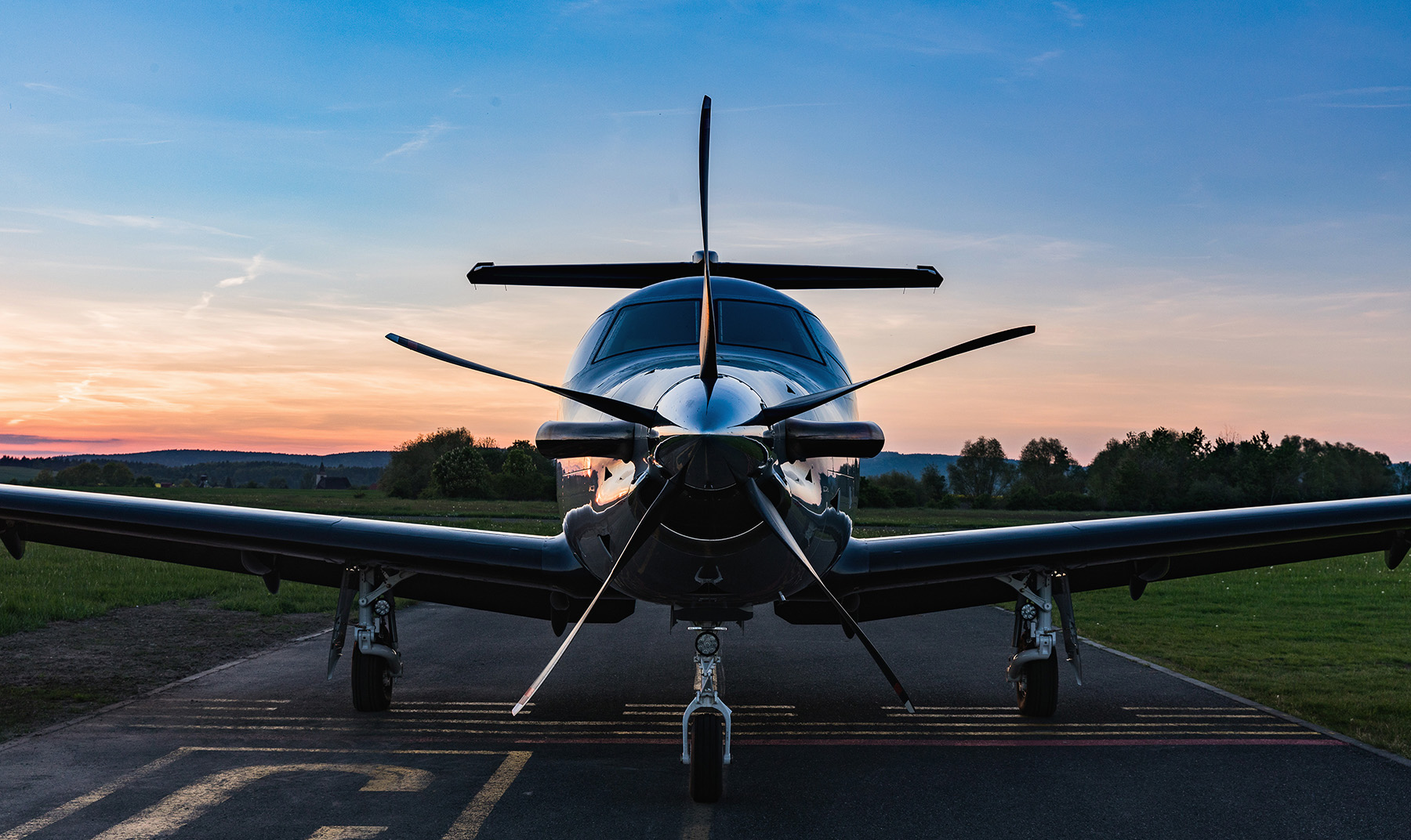
The Swiss single that conquered the Rockies: one legendary PT6 up front, a cabin that swallows people, dogs, and ski bags, and short-field manners that open strips jets cannot touch.
The Numbers That Matter
| Spec | Approximate Figure |
|---|---|
| Class | Turboprop |
| Typical charter seating | 6 to 9 passengers |
| Range | about 1,800 nm |
| Cruise speed | about 280 knots |
| Cabin (length by width by height) | about 16.9 by 5 by 4.8 ft |
| Baggage | about 40 cu ft |
| Lavatory | Yes, forward lav on most tails |
Figures are approximate manufacturer-class numbers for planning; individual aircraft vary by configuration, and your quote reflects the actual tail assigned.
Cabin, Seating, and the Bathroom Question
The cabin is a flat-floor square oval that feels bigger than the single engine up front suggests, and the seats slide and swivel enough to make a card game work.
- Executive: six to eight individual seats in club arrangement
- Commuter: nine forward-facing seats
- Quick-change: seats pull in minutes for cargo, bikes, or a medical litter
Most executive PC-12s carry a forward lavatory seat, curtained on older tails and fully enclosed on many NGX interiors. A few utility configurations skip it, so say so in your quote request if a lav is a must.
Living with a turboprop cabin is its own pleasure once expectations are set right: the seats are genuinely comfortable, the windows are big, and the sound is a steady hum rather than a jet hiss, louder at the front, calmer aft. Cruise happens in the twenties rather than the forties, which means you see the terrain you cross, and on mountain legs that view is half the ticket. Dress for the ramp, not the cabin; the cabin is warm.
Baggage and What Fits
The party trick is the 53 by 52 inch aft cargo door: skis, bikes, dog crates, and band cases load flat without disassembly, and about 40 cubic feet ride behind the seats where you can reach them in flight.
Models and Variants
Charter listings rarely say which generation you are getting unless you ask. The family tree, so the name on your quote means something:
| Variant | What changed |
|---|---|
| PC-12/45 and /47 | the 1994-onward originals, hundreds still working daily |
| PC-12 NG | 2008 refresh with the Honeywell Apex glass cockpit and more power |
| PC-12 NGX | 2020 model with the electronic PT6E engine, bigger windows, and a quieter, restyled cabin |
The Trips It Was Built For
Match the airframe to the mission and the quote gets better. This one earns its keep on: Ski & Mountain Trips Family Vacations Flying with Pets Last-Minute Departures
Flying It Out of Denver
Around Centennial the PC-12 is the mountain-town default: Telluride, Gunnison, Steamboat, and backcountry Idaho all sit comfortably inside its playbook, at an hourly rate that undercuts every jet on this list.
It uses about 2,600 feet of runway on a standard day and is approved for grass and gravel, which is why it reaches strips the jets on this list never will.
From Centennial, published range comfortably covers Las Vegas, Los Angeles, Chicago, New York, Miami.
The weekly reality of this class at Centennial is mountain strips and short regional hops: Telluride mornings, Steamboat weekends, ranch strips no jet will ever see, and the hauling missions where seats come out and gear goes in. When afternoon weather builds over the divide, turboprop crews thread it visually at altitudes jets skip past; it is a different, closer kind of flying, and for Colorado missions it is often flatly the right tool.
How Chartering One Works
The booking mechanics are deliberately boring: fill the form with dates, headcount, and gear; we place the request with certificates that actually operate this class locally; and the best quote lands with everything itemized, aircraft named, photos on request. If this exact type is not available for your dates, the quote says so and offers the closest equivalent cabin rather than pretending. You decide with the whole picture, free.
The Operator Behind the Tail
The tail number on your quote belongs to a certificated Part 135 operator: two professional pilots trained to airline-style recurrency, maintenance on a tracked program, insurance at commercial limits. That infrastructure is most of what the hourly rate buys, and it is why the cheapest number on the internet is not automatically the right one. We place trips with operators we would put our own families on.
When to Book
How far ahead to book depends less on the airplane than the calendar. Ordinary weeks: days of notice suffice, and same-day happens. Holiday corridors, big Denver event weekends, and spring break Fridays: the moment your dates are real, because this class sells out citywide and repositioning an aircraft in costs money that lands on the quote. Flexible dates flip the whole equation and open the discount inventory.
What It Costs to Charter
Turboprops are the value tier of charter: expect the lowest hourly rates on the board, with the trade being speed rather than comfort. Rates move with dates, positioning, and the specific aircraft, which is why we quote trips rather than publish a rate card that would be wrong by Friday. The form below returns a real number, free.